
Newport 30 Mk II
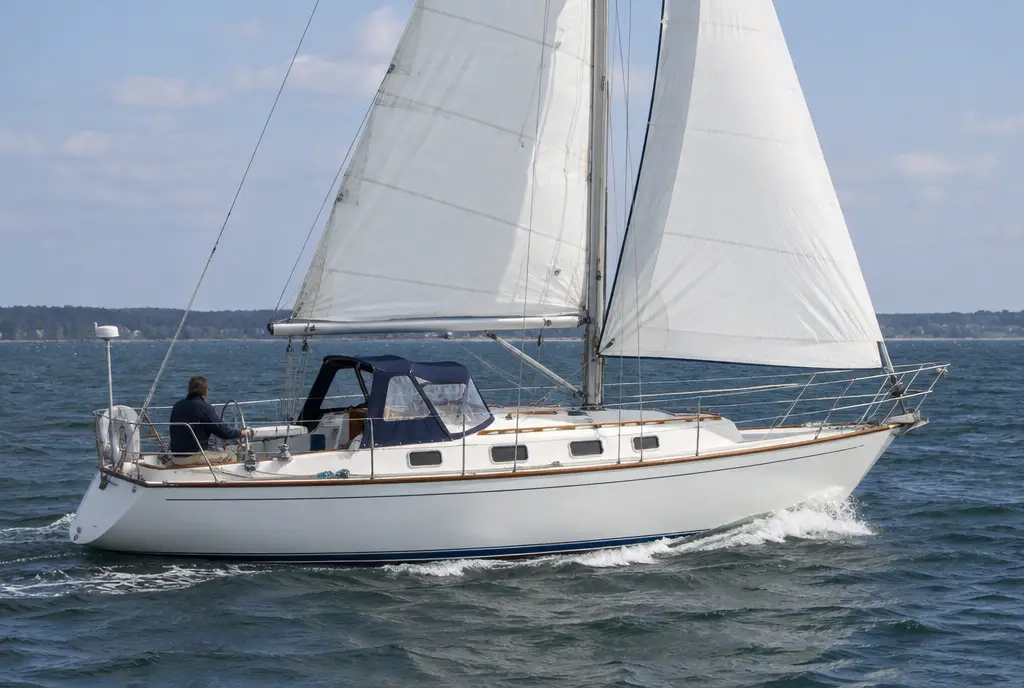
About the Newport 30 Mk II
Researched from public sources for this model. Any individual boat may have been modified or repowered — confirm before relying on any figure.
- Builder
- Capital Yachts
- Designer
- Gary Mull
- Length
- 30 ft
- Waterline
- 26.5 ft
- Beam
- 10.67 ft
- Draft
- 4.75 ft
- Displacement
- 8,000 lb
- Ballast
- 2,600 lb
- Hull
- fiberglass
- Hull / keel
- fin keel
- Rig
- sloop
- Propulsion
- inboard
- Fuel
- 20 gal
- Water
- 60 gal
- Stern thruster
- none
- Steering
- tiller
Sources disagree on first year, last year, engines — left blank rather than guessed.
The Newport 30 ran in three versions: Mk I (1968-73 per Wikipedia, 1973-75 per Good Old Boat), Mk II, and Mk III (1984 per Wikipedia, 1986 per Good Old Boat). Mk II start and end years are disputed (see disputed). The Mk II got a taller mast and shorter boom to rate as an IOR 3/4 tonner; also called Phase II. Shoal keel 3.75 ft optional. Later Mk II boats have a vinyl headliner allowing bulkheads to be tabbed to the deck; earlier ones have a molded liner. Good Old Boat describes the hull as solid glass.
Known problems for this model
-
Osmotic blistering hull
Owners have reported moderate to severe blistering; ask what was done to any boat with a perfect-looking bottom and have a surveyor check.goodoldboat.com
-
Hull-to-deck joint damage deck
The joint is riveted on roughly 6-inch centers with an outward flange that is easily damaged in hard dockings and then leaks; look for distorted toerail sections, as repair is difficult.goodoldboat.com
-
Hidden galvanized keel bolts hull
The lead keel is held by galvanized iron bolts encased in resin inside the keel recess, so they cannot be inspected and can corrode if water gets in; check the keel joint for grounding damage and cracks.goodoldboat.com
-
Cored deck with plywood in load areas deck
The deck uses a synthetic core with marine plywood substituted where extra strength was needed, so poorly bedded hardware can lead to wet, rotted core.goodoldboat.com
Engines & parts
Universal Atomic 4 parts: good
Factory standard engine — you entered “Universal Atomic 4”
Tens of thousands were built (sources say from 40,000 to 50,000). Despite being out of production for decades, the engine is well supported: Moyer Marine sells parts, rebuilt engines, fuel pump rebuilds and exhaust parts, and hosts an owners' forum; Old Lyme Marina and others also supply parts, and electronic ignition upgrades are available.
Parts sources: Moyer Marine
Common problems (3)
-
Raw-water cooling scale and corrosion cooling
Most Atomic 4s are raw-water cooled, so the block scales up and corrodes, especially in salt water; cranking without starting can also flood the engine with seawater through the exhaust.goodoldboat.com · moyermarineforum.com · keelindex.com
-
Gasoline vapor fire/explosion risk fuel
Gasoline vapor is heavier than air and settles in the bilge, so ventilation, blower use and shutting the fuel valve (a stuck carburetor float can overflow) matter.goodoldboat.com
-
Ignition and fuel system faults electrical
Points, condenser, cap and wires, plus gummed carburetors and contaminated fuel, are the most common reasons an Atomic 4 won't run well.keelindex.com · goodoldboat.com
Sources disagree on first year, last year, number built — left blank rather than guessed.
Model sources (5)
sailboatdata.com · goodoldboat.com · en.wikipedia.org · sailboatdata.com · newport30.org
Other Newport models
- Newport 28 / 28 II 1974–1987
Researched from public sources. Spotted an error? The sources are listed above — tell us what they got wrong.