
Tartan 30
About the Tartan 30
Researched from public sources for this model. Any individual boat may have been modified or repowered — confirm before relying on any figure.
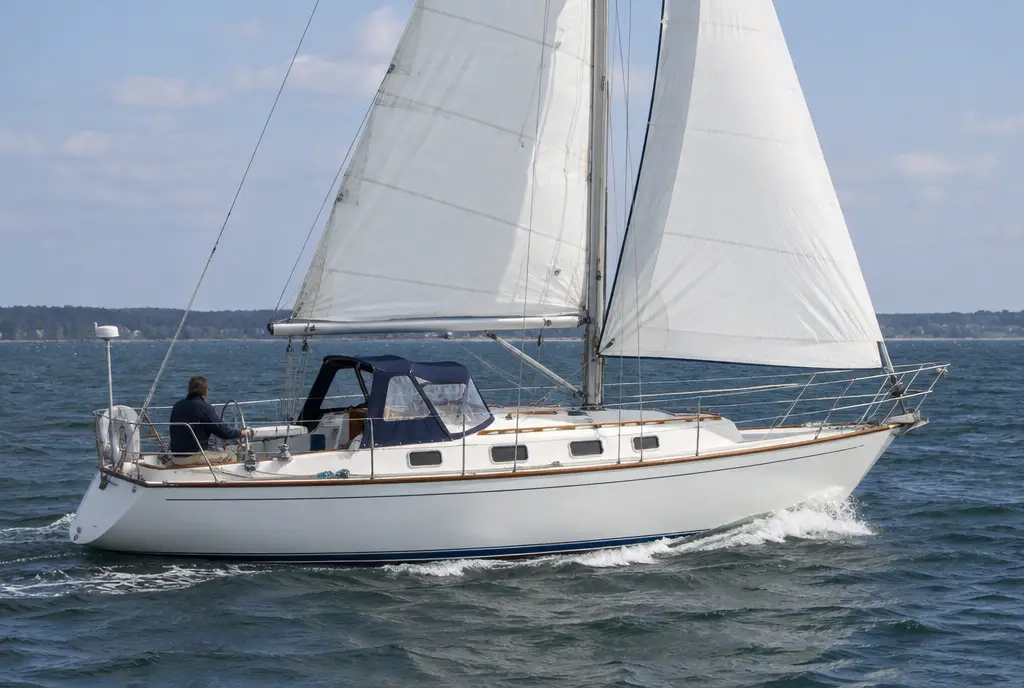
- Builder
- Tartan Marine
- Designer
- Sparkman & Stephens
- Length
- 29.92 ft
- Waterline
- 24.25 ft
- Beam
- 10 ft
- Draft
- 4.92 ft
- Displacement
- 8,750 lb
- Hull / keel
- fin keel
- Rig
- sloop
- Propulsion
- inboard
- Fuel
- 20 gal
- Water
- 30 gal
- Stern thruster
- none
Sources disagree on first year, last year, number built, ballast — left blank rather than guessed.
Production years, hull count and ballast are disputed (see disputed); roughly 600 were built in the 1970s at Tartan plants in Ohio and North Carolina. Standard fin keel with skeg-hung rudder (4.92 ft) and lead ballast on internal stainless bolts; a tall-rig version (sometimes called 30C) has 3 ft more mast, 5.5 ft draft and 500 lb more lead. Sailing Magazine says the forward hull is stiffened with Tensil-Cor laminate and the deck is plywood-cored. Center-galley and aft-galley interiors. Atomic 4 standard; Farymann two-cylinder diesel optional by about 1975 (parts scarce and costly); some owners have fitted Yanmar 2GM20 or 3GM30F diesels. Tanks (20 gal fuel, 30 gal water) from Sailing Magazine. Engine sits amidships under a box in the saloon with excellent access. Keel-stepped mast. Hull material left null: sources do not say whether the Tensil-Cor forward section is a core or a reinforcing laminate.
Known problems for this model
-
Bilge and keel-bolt damage from groundings or bad storage hull
Groundings or poor blocking can loosen floors and keel bolts or flex and tear the hull around the external keel; a misaligned engine or a gap between deadwood and ballast are warning signs. Practical Sailor suggests storing it in a cradle rather than on jackstands.practical-sailor.com
-
Mast step corrosion and tie-rod rigging
Water leaking past the mast partner commonly corrodes the mast step and butt; also check main bulkhead tabbing and the deck-to-step tie-rod.practical-sailor.com
-
Chainplate leaks and deck soft spots deck
Chainplates are prone to leaking, and soft deck spots near penetrations are likely on older boats.practical-sailor.com
-
Gelcoat crazing and chalking hull
Most owners report degraded gelcoat with crazing, voids and chalking; blistering is about average.practical-sailor.com
-
Water backing into Atomic 4 via exhaust engine
Some engines have needed rebuilds after water came back through the exhaust; have the engine checked mechanically.practical-sailor.com
3 more
-
Rusting fuel tank fuel
The fuel tank tends to rust and should be inspected.practical-sailor.com
-
Low companionway sill deck
The companionway sill is too low to stop a flooded cockpit draining below.practical-sailor.com
-
Plywood-cored deck deck
Sailing Magazine describes the deck as a plywood-cored sandwich, so soft spots around fittings mean wet or rotted plywood core.sailingmagazine.net
Engines & parts
Universal Atomic 4 parts: good
Factory standard engine — you entered “Universal Atomic 4”
Tens of thousands were built (sources say from 40,000 to 50,000). Despite being out of production for decades, the engine is well supported: Moyer Marine sells parts, rebuilt engines, fuel pump rebuilds and exhaust parts, and hosts an owners' forum; Old Lyme Marina and others also supply parts, and electronic ignition upgrades are available.
Parts sources: Moyer Marine
Common problems (3)
-
Raw-water cooling scale and corrosion cooling
Most Atomic 4s are raw-water cooled, so the block scales up and corrodes, especially in salt water; cranking without starting can also flood the engine with seawater through the exhaust.goodoldboat.com · moyermarineforum.com · keelindex.com
-
Gasoline vapor fire/explosion risk fuel
Gasoline vapor is heavier than air and settles in the bilge, so ventilation, blower use and shutting the fuel valve (a stuck carburetor float can overflow) matter.goodoldboat.com
-
Ignition and fuel system faults electrical
Points, condenser, cap and wires, plus gummed carburetors and contaminated fuel, are the most common reasons an Atomic 4 won't run well.keelindex.com · goodoldboat.com
Sources disagree on first year, last year, number built — left blank rather than guessed.
Model sources (4)
sailboatdata.com · practical-sailor.com · sailingmagazine.net · goodoldboat.com
Other Tartan models
- Tartan 27 1961–1980
- Tartan 34C 1968–1978
- Tartan 3500 ?–2005
- Tartan 37 (S&S) 1976–1988
Researched from public sources. Spotted an error? The sources are listed above — tell us what they got wrong.